Showing posts with label adventure. Show all posts

Tuesday, June 12, 2012

Book update:

Found at the flea market: The Virgin's Lover (now finished reading, and what an intriguing read it was), and The Other Boleyn Girl (already have read this one, but don't own it) both by Philippa Gregory and The Charlemagne Pursuit, by Steve Berry (excited to read this one! because all his other books are fabulous.) 

more to come on The Virgin's Lover later

Currently reading: 

Archimedes' Claw by Dr. Theodore Morrison Homa, which is awesome and there will be a detailed review of this coming in the next week or so, so stay tuned! 

Phantom Island of the Atlantic: The Legends of Seven Lands that Never Were by Donald S. Johnson, which is so far a fascinating read and which i am planning on incorporating into a photo/art project. 

A History of Pirates: Blood and Thunder on the High Seas by Nigel Cawthorne, which is also fascinating so far, and which is also research for an eventual photo/art project. oddly, the two projects are not connected except temporally and by artistic media, but the books themselves have ended up with a bit of overlap, which just makes it that much more interesting if you ask me. :) 

Tuesday, June 5, 2012

movie list.

while these are not books, movies are still cultural (good ones are anyways), and most of my favorites are related to books anywho, so here are a list of a few movies I would love to own/watch:

Little Ashes, starring Robert Pattinson (lengthier post to come on this later, i have seen it and it is amazing)

Sherlock Holmes and Sherlock Holmes 2

Captain America, Thor, and Iron Man 2

White Collar (ok this one is not a movie its a TV show but i still love it bc it is clever and witty and brilliant and has a lot to do with the art world bc hey, he's an art thief! lol)

The Girl with the Pearl Earring

The Brother's Grimm


Thursday, May 31, 2012

Flying through Ella Enchanted

When I left home for college and moved my already ridiculous collection of books out of my moms house, I purged the stacks of good young adult books that I nonetheless knew I was never going to read again. While they were good, enjoyable, well written books, I knew then that I had outgrown them. Ella Enchanted, by Gail Carson Levine, however, made the cut. Along with The Two Princesses Of Bamarre, also by Levine,  I simply could not part with it.

The characters and story had enchanted me as a 6th grader, and years later I still knew that stories of this sort were far too important to set aside. Through my high school and college years, Levine's stories were my guilty pleasure. They were lighthearted, innocent, and genuinely fun good reads.

Years later I picked the book up again and was exceedingly amused to discover that my middle school self had written  my name along with the name of my then crush and some stereotypical hearts on the inside cover of the book. I read almost all of the book in a single day, mostly in airports and on planes as I flew to California for my cousin's graduation, and I found it as enchanting this time as all the times before.

While my younger self merely liked the book and had no need to ask why, my (hopefully) somewhat more mature and intelligent mind now recognizes the greatness in Levine's writing and art. She masterfully weaves together a story very much of her own original creation with a tale as old as time.

Somehow she manages to take typical fairy tale tropes like fairy godmothers and magic and flip them on their heads, while simultaneously staying completely true to the story of Cinderella. With the expected evil stepsisters, greedy and cruel stepmother, pumpkin coach, and midnight expiration of spells come  dangerously persuasive ogres, gnomes that can see the future, princes that slide down royal banisters, and fairy godmothers that cook in this wonderful tale of a cursed girl with just the right amount of spunk.

Levine even stays true to the original tale's three balls instead of one. And the touch of naming the prince Charmont (Char for short) and the heroine Eleanor (Ella) is as charming as the prince.


Thursday, May 24, 2012


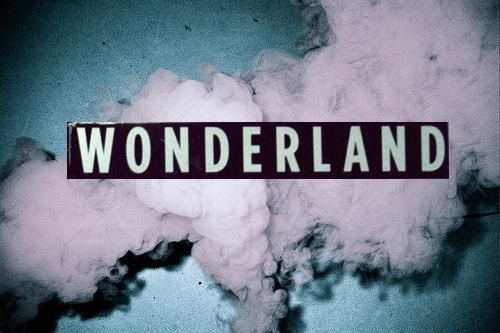
source: http://thebooklist0713.tumblr.com/post/22561654864/the-connection-here-should-be-fairly-obvious

the connection here should be fairly obvious....:) plus it looks like ink in water or smoke or something, which, naturally, i am drawn to. :)

Alice in Neverwhere


Alice in Neverwhere (thoughts on Neverwhere by Neil Gaiman)

A male character, presumably middle aged, and the largest authority of the unknown in the story, offers himself up. He does it for the sole purpose of gaining what is needed to help others. He is beat up, hung on a cross, and killed. Some time later (perhaps even three days later), he is brought back to life. Sound familiar? This description is apt for the death of the Marquis de Carabas in Neil Gaiman’s Neverwhere. But it is also a story so familiar that we celebrate it every year with chocolate eggs. The magic of Neil Gaiman is that he weaves other stories into his own so intricately that we hardly even notice they are there.

My all time favorite passage in the book is another such circumstance. Towards the beginning of the book, Door announces that the group is searching for an angel called Islington. At this point, Richard begins to laugh. The narrator describes the laugh: “There was hysteria in there, certainly, but there was also the exhaustion of someone who had managed, somehow, to believe several dozen impossible things in the last twenty-four hours, without ever getting a proper breakfast” (133). Now, Gaiman’s descriptive and witty writing style is such that this particular description does not stand out as extraordinary in any capacity…unless you are familiar with Lewis Carroll’s Alice in Wonderland, or the movie of the same name directed by Tim Burton and released in 2010.

The movie pulls references from both Alice and Wonderland and Through the Looking Glass by Carroll, so for these purposes it may be a more comprehensive source. It is a reoccurring line in the movie that one should always believe in twelve impossible things before breakfast. This motto becomes essential to the movie when Alice slays the jabberwocky in the end, and so for Gaiman to weave it into his narrative so cleverly is nothing short of supremely impressive.

The parallels between Alice in Wonderland and Neverwhere do not stop at the mention of twelve impossible things. While it is by no means simply a re-telling of the old story, there are a few similarities. For starters, Alice arrives in Wonderland by falling down the rabbit hole. London Below is, well, below. You must go down to get there (generally speaking). And if you go even further down, via Down Street, you arrive at an even more impossible location.

Richard arrives in London Below as completely flummoxed as Alice is. All either character wants to do is return home, to the safety and sanity of their familiar routine. However, both characters’ lives in the above world are predictable at best. Both characters have people telling them what to do, who to be, and how to behave, as well as what to do with the rest of their boring, predictable lives. Neither character seems to have the will or the gall to stand up and say “hold on now, this is my life and I’m going to live it the way I want.”

Nevertheless, upon arrival in the mysterious worlds below England, they both just want to go home. However, the other characters that are native to the underground worlds seem to know better. They know that for one reason or another, Alice and Richard will each be essential to their quest. Alice’s friends, particularly the Mad Hatter, know that she is to be the champion for the White Queen and slay the jabberwocky, a dreaded and imaginative monster. The Mad Hatter also continuously remarks on how Alice has lost her “muchness,” for which I believe we can substitute the word “moxi.” Through the course of the adventure, however, Alice somewhat reluctantly comes into her own, finds her moxi, and proves that she is the Champion, not only for the White Queen, but for herself and her own life.

Richard Mayhew experiences something similar. Strangers remark that he is the hero, they can tell by looking at him, but he also has very little moxi. As the story progresses, Richard too seems to find his ‘muchness’. He proves to be essential to gaining the key, as well as to slaying the imaginative monster of this Wonderland: the Beast of London. In the end, he too realizes that he can have more than the predictable life that is set out for him, and seizes the life he wants (though in this case, it is to return to the underground world).

With other smaller similar aspects, such as riddles (“why is a raven like a writing desk?” is a recurring question in Alice, and Door must answer the riddle of the key in order to obtain it), perhaps the largest similarity is the question of sanity. The entire Ordeal of the Key in Neverwhere is nothing more than a question of sanity. Is this all real? Or has he merely gone insane and been wandering the streets of London? In the end, Richard makes the correct choice to embrace the seeming insanity. It is, after all, best to believe in twelve impossible things before breakfast alone.

Alice and the Mad Hatter also battle with the question of insanity. In the end, what Carroll is trying to tell us all is best summed up in another line that is repeated. First her father tells it to Alice, and then later, she wisely dispenses the same advice to the Hatter. He asks her, “Have I gone mad?” and her sage response is “I’m afraid so. You’re entirely bonkers. But I’ll tell you a secret. All the best people are.” If only someone had been around to point this out to Richard, his Ordeal may not have been so arduous.
this is legitimately my favorite movie, the live version of peter pan. i love it!